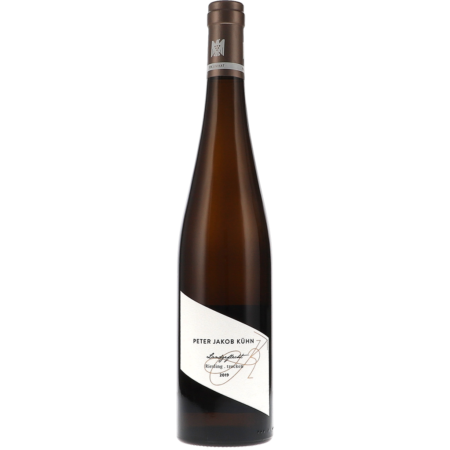
Darkly spiced and extract-rich with fine reduction – smoke, preserved lemon, crushed flint, a touch of petrichor, herbs, mustard seed and a hint of pink pepper.
Palate
Plenty of dark stone, grip and firmness; black berries, lemon, zest, graphite, salt, yeast and herbs – taut, powerful and elegant, with a long development ahead of it.
Character
A dramatic, almost sombre opening with bright flashes of light – reserved in its youth, a Riesling that still needs time.
Pairing
Smoked char, pan-fried mushrooms with herb butter or mature hard cheese.
Notes
Comes from a parcel in the Rothenberg planted ungrafted in 1934 and enclosed by a small wall, without American rootstock – a rare piece of vine history on the Roter Hang.
Tasting note
Colour & appearance
Medium straw yellow in the glass.
Nose
A dramatic, almost sombre opening: smoke, salt-preserved lemon and crushed flint, accompanied by some petrichor, herbs, mustard seed and a hint of pink pepper. A fine reductive note hovers above the darkly spiced, extract-rich aromatic profile — yet bright flashes of light keep breaking through.
Palate
A small miracle of tension and substance. Darkly spiced and rich in extract, with plenty of dark stone, ample grip and firmness. As if the stone were exploding on the tongue in a blend of black berries, lemon, zest, graphite, salt, yeast and herbs. Elegant, yet with enormous drive — the wine pushes forward, remaining taut and aloof, and still needs time. One of the great Rieslings of the vintage.
Finish
Still reserved and taut — this wine needs time.
Terroir & origin
The parcel lies in the Rothenberg, in the steep, northernmost corner of the Roter Hang, directly adjoining the Pettenthal and enclosed by a small wall. The Roter Hang is characterised by red clay slate (Rotliegendes). Carolin Spanier-Gillot and H.O. Spanier have run the family estate Kühling-Gillot together with Battenfeld Spanier from Hohen-Sülzen since 2006 — both houses are members of the VDP, and the Rothenberg ranks among the VDP.GROSSE LAGEN.
Grape variety & vinification
Riesling. The vines were planted ungrafted in 1934, without American rootstock; H.O. Spanier calls the parcel “the DNA of German Riesling”. Both estates have been farmed biodynamically since 2005 and are organically certified. In the cellar, the house relies on spontaneous fermentation in large wooden casks and stainless steel tanks, minimal sulphur additions and no fining agents.
Food recommendations
Its tautness and salty spice call for characterful dishes: pan-fried turbot with herb butter, cured char with horseradish, duck breast with a dark jus or mature hard cheese.
Special features
Ungrafted vines from the 1930s — a living relic from the era before the law mandated phylloxera-resistant rootstocks. In 2018, the Rothenberg GG wurzelecht was awarded 100 points by Gault & Millau as Germany’s finest dry Riesling.
From the same estate
More wines from Kühling-Gillot & Battenfeld-Spanier