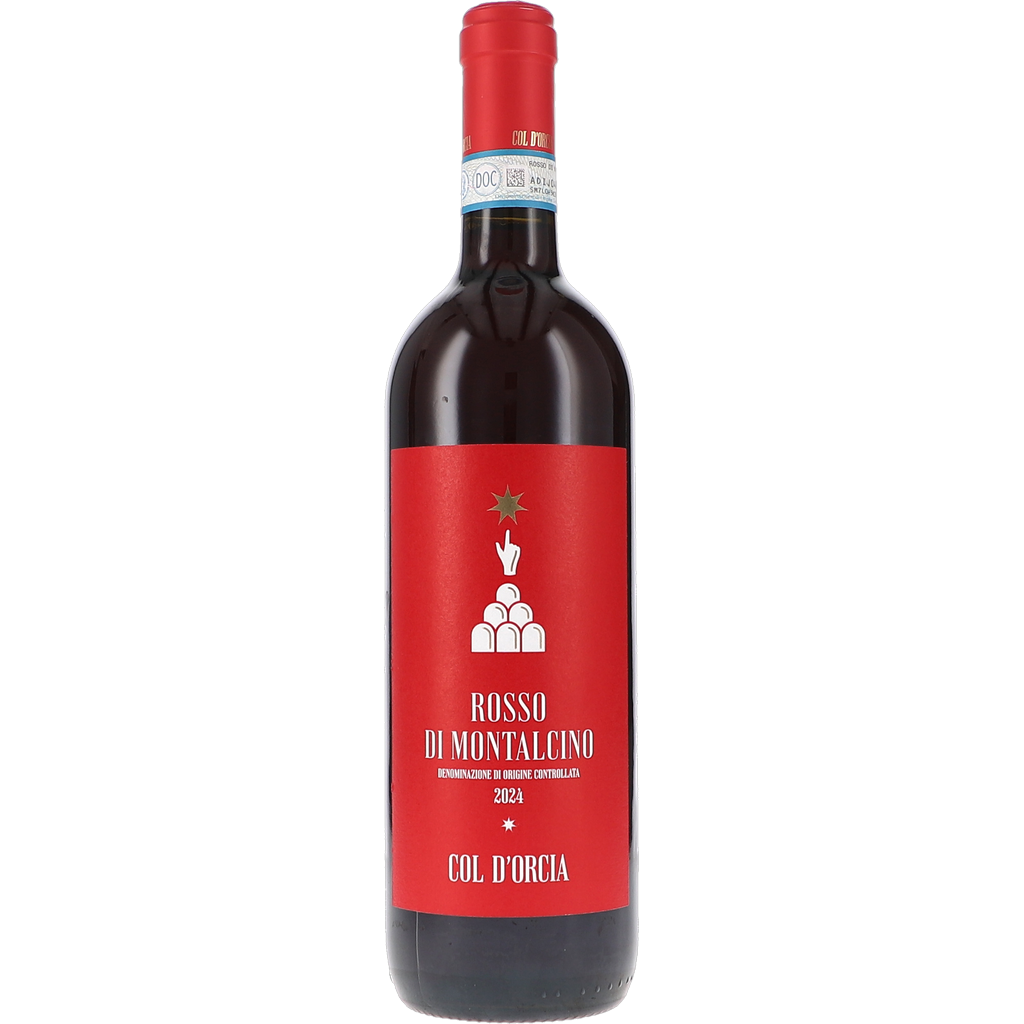
A dry, single-varietal Sangiovese from Tuscany – more accessible and ready to drink earlier than Brunello, yet with the same faithful expression of its UNESCO World Heritage terroir in the Val d'Orcia.
Ripe cherry and red berries, accompanied by floral notes of violet, Mediterranean herbs and a subtle hint of leather and spice.
Palate
Juicy cherry fruit meets vibrant acidity and fine-grained tannins; medium-bodied, dry and with a clean, fresh finish.
Character
A distinctive, straightforward Sangiovese with structure and drinkability – no lesser Brunello, but a wine with its own identity that offers pleasure even in its youth.
Pairing
Homemade pasta with wild game ragù, medium-aged Tuscan Pecorino, Bistecca alla Fiorentina.
Notes
Col d'Orcia played a key role in establishing Rosso di Montalcino as an independent DOC; since 2010, the estate has been the largest certified organic winery in Tuscany and received the 2023 SNAIL Award from the Slow Wine Guide for sustainable viticulture.
Tasting note
Character
A Sangiovese that does not aspire to the stature of its big brother Brunello, but instead makes itself known through drinkability and freshness. Cherry fruit, floral notes, a vibrant acidity – this Rosso di Montalcino is not meant for cellaring, but for enjoying now. Col d’Orcia played a pivotal role in establishing this DOC as an independent category – not a second wine, but a distinct interpretation of the terroir.
Terroir & Origin
The vines are rooted in the Val d’Orcia, a UNESCO World Heritage Site southwest of Montalcino. The River Orcia marks the boundary of the Brunello zone here. Col d’Orcia cultivates 142 hectares of vines across a total estate of 530 hectares – half of which is woodland, alongside olive groves with 400-year-old trees. Since 2010, the estate has been the largest certified organic winery in Tuscany. Sheep and goats graze between the vine rows, and compost from the estate’s own closed-loop system nourishes the soils.
Grape Variety & Vinification
Pure Sangiovese, the grape variety that made Montalcino world-famous. In the Rosso, it reveals its more accessible side: less tannic weight than in the Brunello, more immediate fruit. The Marone Cinzano family – at the estate since 1973, previously a vermouth dynasty in Turin – relies on traditional ageing in large Slavonian oak casks. Not a trend, but continuity.
Food Pairings
An everyday wine with substance: pasta al ragù, pizza with spicy salami, medium-aged Pecorino. Also a reliable choice with roast chicken or crostini with liver pâté. The vibrant acidity cuts through richness, whilst the moderate tannin structure remains discreetly in the background.