
 EN
 DE
 FR
 IT
The Côte d’Or in brief
In short: The Côte d’Or is a narrow, predominantly east-facing slope stretching from Dijon to Maranges and Chagny on the border with the Saône-et-Loire département. Over a length of almost 50 km and often only a few hundred metres wide, the Côte de Nuits in the north, devoted almost entirely to Pinot Noir, is followed in the south by the Côte de Beaune with Pinot Noir, Chardonnay and the great white wines. The classification comprises four levels: Regional, Village, Premier Cru and Grand Cru. With us you will find wines from 21 producers of the Côte d’Or, from Coteaux Bourguignons for €18.50 to Chambertin Grand Cru.
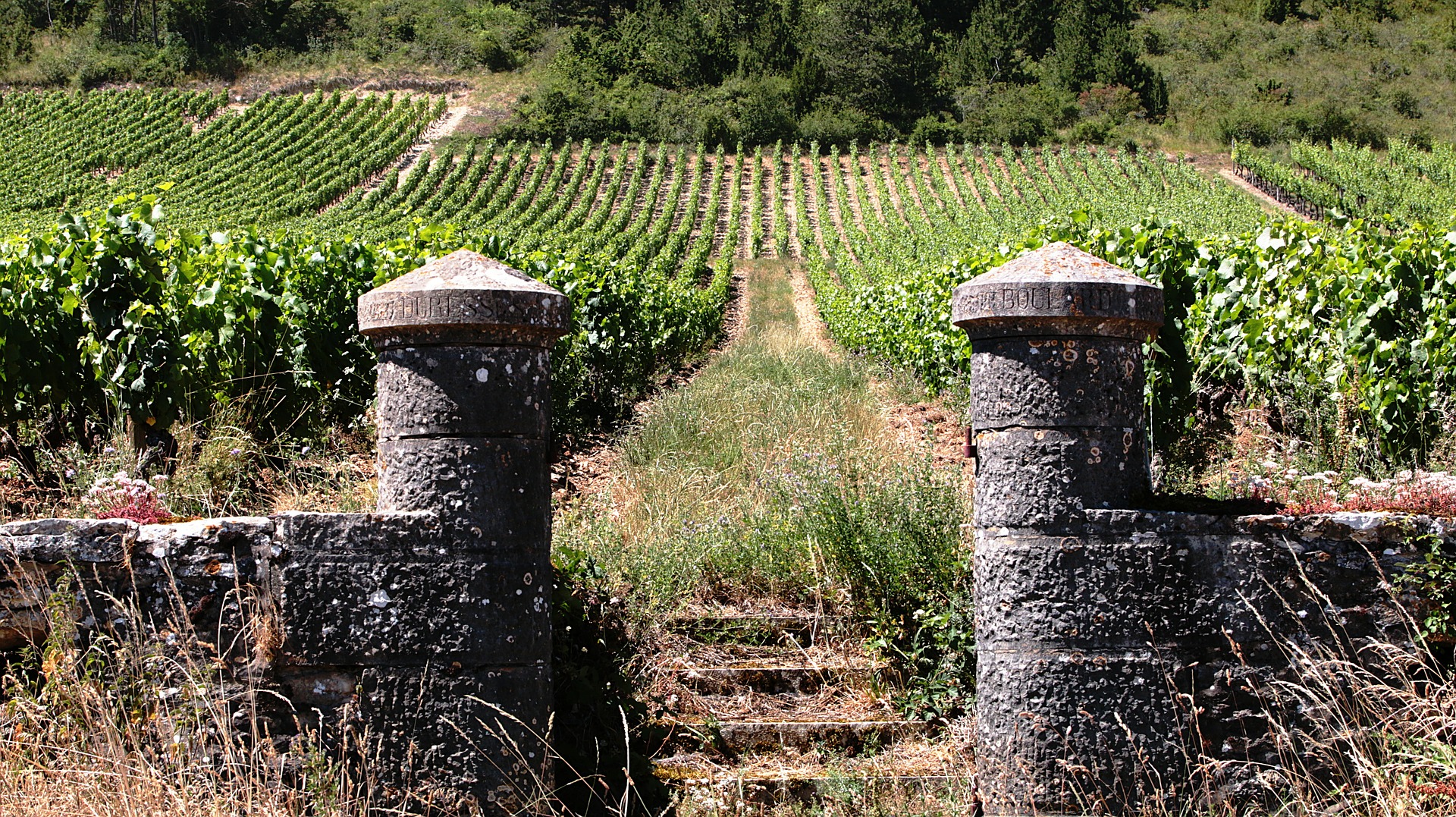
Having roamed between the north and south of Burgundy, it is now time to explore the monster that lies in the middle. Like a sleeping dragon, the Côte d’Or stretches almost 50 km southwards from Dijon to Chagny.
The name does not refer to the prices that some of its matured wines can reach, but rather to the colour in which the slopes are painted by the autumn leaves of the vines. Another common notion is that the name is an abbreviation of Côte d’Orient, as the slopes where the vines grow face (mainly) east.
A monster, a dragon. Perhaps that is a little too much, but everyone feels somewhat daunted when talking about one of the most complex and precious wine regions in the world.
Côte de Nuits and Côte de Beaune: the two halves
Let us begin with some cold facts, especially the simple ones. In viticultural terms, the Côte d’Or is divided into two areas:
- The Côte de Nuits in the north, named after the town of Nuits-Saint-Georges.
- The Côte de Beaune in the south, named after the town of Beaune.
The former is home to some of the finest red wines made from Pinot Noir, while the latter produces outstanding white wines from Chardonnay alongside its reds. The soil consists mainly of Jurassic limestone, which benefits both Chardonnay and Pinot Noir.
End of the simple part; now the monstrosity begins.
The villages of the Côte d’Or from north to south
The tables read southwards from Dijon, first along the Côte de Nuits, then across the Côte de Beaune as far as Maranges. The grape variety indicates what predominates in each village; the character summarises the style and a defining feature. The final column lists the producers whose wines from this village we carry.
Côte de Nuits
| Village | Grape variety | Character | Our producers |
|---|---|---|---|
| Marsannay | Pinot Noir, also Chardonnay | Cool, fruit-fresh wines from the northernmost village near Dijon, with its own rosé and no Premier Crus. | Bruno Clair, Charlopin Tissier, Jérôme Galeyrand, Trapet Père & Fils |
| Fixin | Pinot Noir | Powerful red wines made almost exclusively from Pinot Noir, rustic and tannic in their youth, with a distinctly perceptible, firm structure. | Jérôme Galeyrand |
| Gevrey-Chambertin | Pinot Noir | Dark, powerful, deep red wines from the largest appellation of the Côte de Nuits, crowned by nine Grand Crus. | Bruno Clair, Bruno Clavelier, Charlopin Tissier, Hubert Lignier, Jérôme Galeyrand, Trapet Père & Fils |
| Morey-Saint-Denis | Pinot Noir, little Chardonnay | Red wines between the power of Gevrey and the finesse of Chambolle, with several Grand Crus and little white wine. | Bruno Clair, Hubert Lignier |
| Chambolle-Musigny | Pinot Noir | Finest, fragrant red wines from limestone-rich, clay-poor soils, with the Grand Crus Musigny and Bonnes-Mares. | Bruno Clair, Bruno Clavelier, Hubert Lignier |
| Vougeot | Pinot Noir, some Chardonnay | Red wines around the walled Grand Cru Clos de Vougeot, plus some white wine. | Charlopin Tissier, Hubert Lignier, Jérôme Galeyrand |
| Vosne-Romanée | Pinot Noir | Velvety, spicy red wines with silky tannins; Grand Crus such as Romanée-Conti, La Tâche and Richebourg define the village. | AS Sirugue-Noëllat, Bruno Clair, Bruno Clavelier, Charlopin Tissier |
| Nuits-Saint-Georges | Pinot Noir, little Chardonnay | Earthy, firm, structured red wines; many Premier Crus but no Grand Cru in the village that gave the Côte de Nuits its name. | Bruno Clavelier |
Côte de Beaune
| Village | Grape variety | Character | Our producers |
|---|---|---|---|
| Ladoix | Pinot Noir and Chardonnay | Little known, with a share of the Corton hill and both red and white wines from the immediate vicinity of great vineyard sites. | AS Sirugue-Noëllat, François de Nicolay |
| Aloxe-Corton | Pinot Noir; Chardonnay in Corton-Charlemagne | Powerful reds on the Corton hill, home to the only red Grand Cru of the Côte de Beaune as well as white Corton-Charlemagne. | Bruno Clair, Bruno Clavelier, Chandon de Briailles, Charlopin Tissier, Henri & Gilles Buisson |
| Pernand-Vergelesses | Pinot Noir and Chardonnay | Cool, taut white wines and fine reds, with a share of Corton-Charlemagne on the Corton hill. | Chandon de Briailles, Charlopin Tissier |
| Savigny-lès-Beaune | Pinot Noir | Aromatic, accessible red wines with a softer impression, predominantly from Pinot Noir, in the immediate vicinity of Beaune. | Boris Champy, Bruno Clair, Chandon de Briailles |
| Beaune | Pinot Noir, also Chardonnay | Round, medium-bodied red wines with many Premier Crus but no Grand Cru, in the town of trade and the Hospices. | Boris Champy, Henri & Gilles Buisson, Thomas Morey |
| Pommard | Pinot Noir | The most powerful, most tannic red wines of the Côte de Beaune, shaped by more clay-rich soils and built for ageing. | Boris Champy, Clos du Moulin aux Moines, Henri & Gilles Buisson, Hubert Lignier, Lejeune, Pierre & Louis Trapet, Rougeot Père & Fils |
| Volnay | Pinot Noir | The finest, most aromatic red wines of the Côte de Beaune; Volnay-Santenots grows on Meursault territory but is sold as Volnay. | Clos du Moulin aux Moines, Darviot-Perrin, Henri & Gilles Buisson, Jean-Marc & Thomas Bouley, Rougeot Père & Fils, Rémi Jobard |
| Monthélie | Pinot Noir, also Chardonnay | Predominantly red wines in a fine, aromatic style from the small village between Volnay and Meursault, along with some Chardonnay. | Darviot-Perrin, Hubert Lignier, Rougeot Père & Fils, Rémi Jobard |
| Saint-Romain | Chardonnay and Pinot Noir | Cool, taut white wines from the high-altitude site behind the main ridge, plus red wines from Pinot Noir. | Clos du Moulin aux Moines, Henri & Gilles Buisson, Rougeot Père & Fils |
| Auxey-Duresses | Pinot Noir and Chardonnay | Taut white wines and medium-bodied reds from the side valley behind Meursault, where Pinot Noir and Chardonnay grow. | Clos du Moulin aux Moines, Pierre & Louis Trapet |
| Meursault | Chardonnay | Broad, nutty, buttery to mineral white wines, without a Grand Cru but with the famous Premier Crus Les Perrières and Les Charmes. | AS Sirugue-Noëllat, Clos du Moulin aux Moines, Henri & Gilles Buisson, Rougeot Père & Fils, Rémi Jobard, Thomas-Collardot |
| Puligny-Montrachet | Chardonnay | Precise, taut, finely structured white wines with Grand Crus such as Montrachet and Chevalier-Montrachet; deep cellars are rare due to the groundwater. | Clos du Moulin aux Moines, Thomas-Collardot |
| Chassagne-Montrachet | Chardonnay and Pinot Noir | Fuller, fruitier white wines than in Puligny, from soils richer in clay and marl, plus red wine and a share of Montrachet. | Darviot-Perrin, Thomas Morey |
| Saint-Aubin | Chardonnay | Taut white wines from the higher side valley behind Puligny and Chassagne, predominantly shaped by Chardonnay. | Thomas Morey |
| Santenay | Pinot Noir | Powerful, earthy red wines predominantly from Pinot Noir, at the southern end of the Côte de Beaune before Maranges. | Boris Champy, Henri & Gilles Buisson, Thomas Morey |
| Maranges | Pinot Noir | Rustic, juicy red wines from Cheilly, Dezize and Sampigny, already in Saône-et-Loire at the southern end of the Côte de Beaune. | Thomas Morey |
Soils: limestone, marl and the mid-slope
The region has long puzzled wine geologists. As early as the 12th century, Cistercian and Benedictine monks were already aware of the differences between the individual crus. In the 14th and 15th centuries, the Dukes of Burgundy did everything in their power to promote the region’s wine development.
In more recent times, soils and subsoils, winds and temperatures have been measured precisely. And yet no one can definitively prove the link between the incredible variety of nuances that distinguish each plot from the next and the magnificent wines produced here.
It is a combination of all these factors. The climate (mesoclimate) and the soil of each cru (for example, oolitic limestone is more porous and provides better drainage compared to marl); the small valleys (known as combes) that mix up the soil composition and ultimately alter the orientation of the slopes; and the decisions made by each individual winemaker (whole or partially destemmed grapes, maceration, fermentation temperature, type of wooden casks and so on).
The fault scarp and its layers
The Côte d’Or is a fault scarp. During the Tertiary period, the Bresse Graben subsided to the east of today’s slope, opening up the Saône plain; the limestone plateau fractured. This is why layers of different ages appear side by side on the slope. Its subsoil consists of Middle and Upper Jurassic limestone and marl, yet the mixture changes from place to place and according to the position on the slope.
Limestone and marl behave differently in the vineyard. Oolitic limestone is more porous and drains better; marl, a mixture of clay and limestone, retains water more effectively. In the glass this does not translate into a mechanical formula, but rather into a reliable interpretation: limestone emphasises tension and finesse, while marl lends fullness and structure. On the Côte de Nuits, harder Middle Jurassic limestones predominate, including Bajocian and Bathonian, as well as the Comblanchien limestone – named after a village on the Côte – interspersed with marls. Fossilised oysters, Ostrea acuminata, are found in the Bajocian marls around Gevrey. The Côte de Beaune displays more marl and younger Upper Jurassic strata, particularly Oxfordian; the white marls on the upper slope of Corton are the home of Corton-Charlemagne.
Why the mid-slope matters
The mid-slope combines this geology with favourable growing conditions. At the crest lie thin, stony, cooler soils and forest. At the foot, deeper, heavier, more fertile alluvial soils accumulate. In between, the mi-côte unites drainage, sunlight and sufficient soil depth. Grand and Premier Crus therefore lie roughly in the middle of the slope, with Village sites below them; regional Bourgogne wines frequently come from the flat soils east of the D974, the former Route nationale 74 at the foot of the slope. This is a rule of thumb, not a mathematical boundary. Combes, small transverse valleys such as the Combe de Lavaux near Gevrey or the Combe d’Orveaux near Chambolle, channel cool air and debris onto the slope while simultaneously altering the exposure.
Vintages: why the weather decides so much
And let us not forget that the Côte d’Or is strongly influenced by variations in the weather, meaning that each vintage can differ greatly. In some years, Pinot Noir struggled to ripen fully (2004, 2008, 2011), forcing producers to keep yields low. Some hot vintages can display more tannins (1976 and 1983). And then there are the incredibly fine vintages of 1978, 1990, 1999 and 2005.
Our wine vintage chart shows how the more recent vintages compare.
Classification: from Bourgogne to Grand Cru
But that is not enough, is it? Let us take a look at the classification of the various crus. Good luck. The Grand and Premier Crus are mainly situated between 250 and 300 metres above sea level, where the slopes become steeper and the topsoils rockier.
There are 32 Grand Crus, 24 of them in the Côte de Nuits. They are identified by a single vineyard name (Montrachet, Chambertin, Echézeaux, to name but a few). Premier Crus bear the name of the village followed by that of the vineyard (e.g. Beaune-Les Grèves) or, if they are a blend of different Premier Crus, the village name plus the word “Premier Cru” (e.g. Nuits-Saint-Georges Premier Cru). Third comes the Appellation Communale, or village wines. They have the right to use the village name (e.g. Marsannay), sometimes followed by the name of the specific vineyard in smaller print.
At the bottom rung we have wines that may only be sold as “Bourgogne”. Although this ranking system can give some indication of the quality of the wines, we must remember that great bargains can often be found among the lower classifications. One example worth mentioning is the area of the Hautes-Côtes (“de Beaune” and “de Nuits”), which lies above 400 m and is exposed to lower temperatures. The wines are light and fine and, in some hot years such as 2009, truly exceptional.
| Level | What goes on the label | Where on the slope |
|---|---|---|
| Regional | “Bourgogne”, “Bourgogne Côte d’Or”, “Bourgogne Aligoté”, “Passetoutgrains” or “Hautes-Côtes” | Mainly flat land east of the D974; the Hautes-Côtes lie higher up behind the slope, above 400 m |
| Village | Village such as “Meursault” or “Gevrey-Chambertin”; an unclassified lieu-dit may be added in small print | Mainly below mid-slope |
| Premier Cru | Village and vineyard site, such as “Beaune 1er Cru Les Grèves”; for a blend, village plus “Premier Cru” | Above all on the mid-slope, mostly between 250 and 300 m |
| Grand Cru | Only the vineyard name, such as “Chambertin”, “Clos de Vougeot” or “Montrachet” | Likewise predominantly on the mid-slope, mostly between 250 and 300 m |
Climats: the World Heritage of parcels
The levels regulate the indication of origin, but only together with the concept of Climat do they explain how Burgundy reads its vineyards. A Climat is a precisely delimited, named parcel with its own soil and climatic conditions. It is therefore more than a cadastral number: the name links a particular spot on the slope with the conditions prevailing there and the wine that emerges from it. This fine mapping was inscribed on the UNESCO World Heritage List on 4 July 2015 as “Les Climats du vignoble de Bourgogne”. The World Heritage Site comprises 1,247 Climats between Dijon and Maranges as well as the old town of Dijon and the town of Beaune as commercial and administrative centres.

The village names, meanwhile, speak of the power of famous vineyard sites. In the 19th century, many places appended the name of their best-known vineyard to the village name; Gevrey became Gevrey-Chambertin in 1847, while Puligny and Chassagne adopted “-Montrachet” and Aloxe “-Corton”. Two further terms define ownership and boundary: a Clos is a vineyard enclosed by a wall, frequently a legacy of the monasteries. Monopole, on the other hand, denotes a vineyard in the sole ownership of one estate. The terms are not synonymous: the wall says something about the enclosure, the Monopole something about ownership. The Clos de Vougeot goes back to the Cistercians of Cîteaux; Cistercians and Benedictines were already distinguishing individual crus in the 12th century.
- Bourgogne Aligoté 2024, AS Sirugue-Noëllat €22.50
- Bourgogne Hautes-Côtes de Beaune rouge “Altitude” 2023, Boris Champy €34.00
- Côte de Nuits-Villages “Vieilles Vignes” 2023, Charlopin Tissier €35.50
- Bourgogne Côte d’Or “Les Vaux” Sans Sulfite Ajouté 2023, Rougeot Père & Fils €39.00
- Bourgogne Hautes-Côtes de Beaune blanc 2024, Thomas-Collardot €42.99
- Bourgogne Aligoté “En Buzigny” Vieilles Vignes 2024, Rémi Jobard €47.01
What do the wines of the Côte d’Or taste like?
The Côte d’Or is definitely a place where any wine lover can lose themselves forever – and most pleasantly so.
The red wines may be weightier or more elegant, but they all display great concentration. Over time, the bouquet of soft red fruits becomes ever more complex, reaching what the French call sous-bois.
The white wines are distinguished by their full body, balanced acidity and the persistence of their aromas. The woody notes fade with time, making way for the finesse of the fruit.
Sous-bois
“Sous-bois” means undergrowth. In the glass, it describes what a mature Pinot Noir from Burgundy develops over the years: forest floor, mushrooms, damp leaves, moss, a hint of truffle alongside the receding red fruit. It is the sign that the wine has reached maturity and, for the great crus of the Côte d’Or, the very reason why one lays them down for so long in the first place.
A little compass from Living Wines
Chavy-Chouet
Chavy-Chouet can be a wonderful starting point for exploring the possibilities that the region has to offer.

Situated in the Côte de Beaune, the estate – today run by Romaric Chavy and his wife – offers an impressive portfolio of vineyard sites. The outstanding parcels in Meursault (“Les Narvaux”, “Les Charmes”, “Les Genevrières” and the monopole “Clos des Corvées de Citeaux”) are joined by the Premier Crus “Les Chanlins” in Pommard and “Les Folatières” in Puligny-Montrachet. The “basic” Bourgogne blanc and Bourgogne rouge already represent tremendous value at a very affordable price, while the Bourgogne Aligoté “Les Maréchaux” can give you an idea of this rediscovered indigenous grape variety.
I can only attempt to describe the style of Chavy-Chouet as fresh and precise, driven by power and finesse. Despite his young age, Romaric Chavy has seven generations of winemakers behind him. He tends vines that are up to 70 years old, cultivated without herbicides for 30 years and organically for several years now.
We currently stock the Bourgogne Rouge “La Taupe” 2021 from Chavy-Chouet.
Trapet Père & Fils
In the Côte de Nuits, Domaine Trapet Père et Fils has set out to extract the very essence of the Gevrey-Chambertin terroir.

The concept of terroir is far more than just a place. It is the fusion of soil, climate and people. The “Chambertin Grand Cru” encapsulates all of this in a single bottle. There is the prestige of a slope whose neighbouring site, Clos de Bèze, already appeared in a deed of gift in the year 630, but also the moment when Arthur Trapet decided to buy his first piece of land here in 1919. There is the complexity of a soil of marl limestone with excellent clay. There is an entire, infinite universe.
“Cuvée Ostrea” is a blend of the oldest vines on the estate. The name comes from the fossilised oyster Ostrea acuminata, which was found in the parcels of Gevrey. The wine itself is a homage to the soil, here to remind us how the land is the very principle of every winemaker’s work.
Domaine Trapet Père et Fils is a must for anyone wishing to explore the deep underworld that lies beneath Burgundy, especially all the sweet little nuances of Gevrey-Chambertin.
- Marsannay rouge 2023, Trapet Père & Fils €42.99
- Fixin “Champs de Vosger” 2023, Jérôme Galeyrand €72.99
- Gevrey-Chambertin Cuvée Ostrea 2023, Trapet Père & Fils €99.50
- Chambolle-Musigny “Les Bussières” 2023, Hubert Lignier €129.00
- Vosne-Romanée “La Combe Brûlée” Vieilles Vignes 2023, Bruno Clavelier €157.50
- Nuits-Saint-Georges 1er Cru “Aux Cras” Vieilles Vignes 2023, Bruno Clavelier €241.00
Darviot-Perrin
Back in the Côte de Beaune, we find the estate Darviot-Perrin. It has its origins in the experience and the land that Didier Darviot received from his father-in-law and viticultural legend Pierre Perrin. Today, the 11-hectare estate encompasses some of the finest vineyards for Burgundian red and white wines. The focus lies on biodynamic care of the vineyards and minimal intervention, with the aim of preserving the quality of the grapes as perfectly as possible.
Didier retired in 2017 and handed over the management of the estate to his son Pierre-Antonin, who converted production to 100% biodynamic. The vines in the vineyards are 60 years old on average, some even over 90 years old, and are fertilised with organic compost.

The soils of Chassagne-Montrachet are slightly less stony than those of Puligny, with more clay and somewhat more marl. This yields Chardonnays that are a little fuller, juicier and fruitier than their neighbours.
Chassagne-Montrachet: Thomas Morey
The Chassagne-Montrachet 1er Cru Les Macherelles by Thomas Morey is a remarkable interplay between nature’s gifts and the winemaker’s craftsmanship. Born in the gravelly limestone soil of his small, venerable vineyard, this wine captivates with its pronounced character.
Cool yet ripe, with volume on the palate, a saline streak and a firm finish: a Chassagne that demonstrates what the village’s more clay- and marl-rich soils can achieve compared with the tautness of Puligny.
- Bourgogne Rouge “La Taupe” 2021, Chavy-Chouet €27.50
- Monthélie “Les Crayes” 2024, Darviot-Perrin €45.01
- Saint-Aubin 1er Cru Le Puits 2024, Thomas Morey €69.50
- Chassagne-Montrachet 1er Cru Les Macherelles 2024, Thomas Morey €84.00
- Volnay-Santenots 1er Cru 2024, Darviot-Perrin €113.00
- Meursault Les Narvaux 2024, Rémi Jobard €120.50
We wish you great pleasure in tasting them again! Here you will find all our Burgundy winemakers.
Frequently asked questions
What is the Côte d’Or?
The Côte d’Or is a narrow, predominantly east-facing vineyard slope stretching from Dijon to Maranges and Chagny on the border with Saône-et-Loire. It is almost 50 km long and frequently only a few hundred metres wide. The Côte de Nuits lies in the north, the Côte de Beaune in the south.
What is the difference between the Côte de Nuits and the Côte de Beaune?
The Côte de Nuits is devoted almost entirely to Pinot Noir and is home to 24 of the Côte d’Or’s 32 Grands Crus. The Côte de Beaune unites Pinot Noir and Chardonnay, is renowned above all for its great white wines and comprises eight Grands Crus, including Corton, Corton-Charlemagne and Montrachet.
What do Premier Cru and Grand Cru mean in Burgundy?
Premier Cru and Grand Cru are the two highest tiers of the Burgundian classification. A Premier Cru label combines the village and the vineyard site, such as Beaune 1er Cru Les Grèves; in the case of a blend of several Premiers Crus, the label shows the village and “Premier Cru”. For a Grand Cru, only the vineyard name appears without the village, such as Chambertin, Clos de Vougeot or Montrachet.
Which grape varieties grow on the Côte d’Or?
Pinot Noir and Chardonnay are the defining grape varieties; Aligoté is also grown at regional level. The Côte de Nuits is almost entirely red, while the Côte de Beaune, alongside red wine, is particularly known for great Chardonnays. Marsannay is the only village appellation on the Côte d’Or that also produces its own rosé.
How long can red Burgundy from the Côte d’Or be cellared?
Village wines can usually mature for a few years; Premiers and Grands Crus often need five to ten years or more. With maturity, sous-bois notes emerge. Our vintage chart shows how individual vintages develop.