
 EN
 DE
 FR
 IT
Chablis in brief
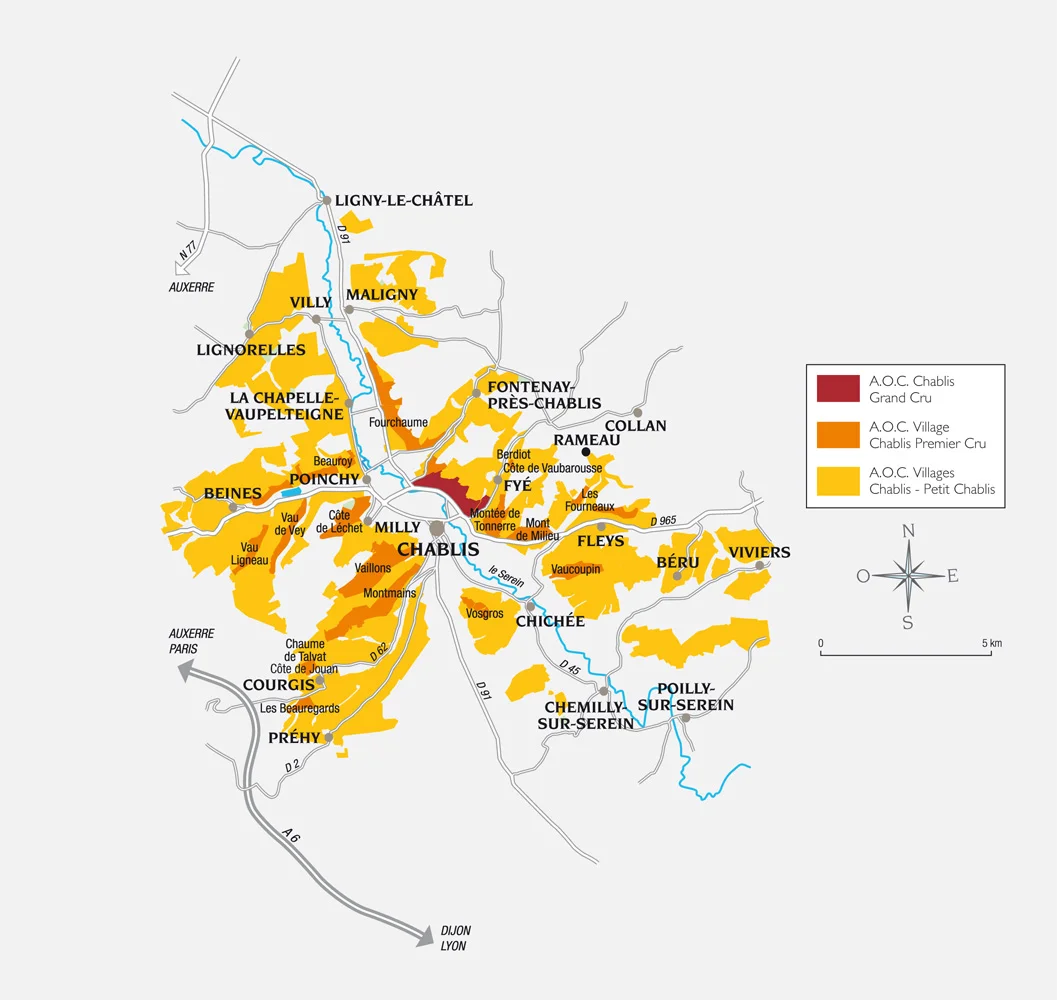
In short: Chablis is the northernmost wine-growing area of Burgundy, situated around the town of the same name in the Yonne département on the River Serein, and it permits only one grape variety: Chardonnay. The appellation has four tiers, from Petit Chablis via Chablis and Chablis Premier Cru (40 climats) to Chablis Grand Cru, whose seven climats cover around 100 hectares on a single south-west-facing slope. The finest vineyard sites stand on Kimmeridgian marl full of fossilised oyster shells, while the simpler ones mostly lie on the younger Portlandian limestone of the plateaus. The map below shows where everything is located; with us, Chablis begins at €22.00 with the Petit Chablis from Domaine de l’Enclos and extends up to the Grands Crus and the Monopole Clos Béru.
Burgundy! A name that immediately conveys finesse. Chardonnay and Pinot Noir at the highest level, but Aligoté and Gamay also contribute to the region’s astonishing portfolio. Names such as Côte d’Or, Beaune, Pouilly-Fuissé and Chablis are firmly anchored in the minds of all wine lovers and on the wine lists of the most important restaurants.
But what is the reason for Burgundy’s immortal fame? As usual, we can try to trace various factors, from soil composition to socio-historical matters. To grasp at least partially the complexity of this fragmented area, we must proceed carefully, step by step. The first step leads north, to Chablis.
Location and climate: Chablis, the north of Burgundy
Chablis lies quite far north and is separated from the other Burgundy regions by the Morvan hills. It has more in common with the climate of Champagne than with the Côte d’Or, for example.
Chardonnay is “the” grape variety of Chablis. The only one permitted by the Chablis Appellation d’Origine Contrôlée and, for some critics, the purest expression of this variety. The cold climate clearly influences the harvest strongly: the wines turn out less fruity and more acid-driven. Frost is one of the greatest risks in the area, most drastically so in 1957, when it almost completely destroyed the vintage.
But what defines all the Grands and Premiers Crus of the region is the goût de pierre à fusil, a subtle taste of flint. It is due to the best-kept secret of Chablis: the Kimmeridgian marl. This ancient soil is around 150 million years old. It is a calcareous soil type consisting of a mixture of limestone, clay and fossilised oyster shells.
Well, a cold climate and high minerality … but don’t think that Chablis is a harsh wine! The location of the heart of Chablis, its Grands and Premiers Crus, makes all the difference.

The four tiers: Petit Chablis, Chablis, Premier Cru, Grand Cru
The four tiers of Chablis do not form a simple ladder from bad to good wine. They classify origin, slope, aspect and soil, and thus the relationship between ripeness, concentration and tension. Of around 5,800 hectares of vineyard area, roughly two thirds belong to Chablis, the broad middle tier of the region. Its slopes, planted predominantly on Kimmeridgian marl and partly on Portlandian limestone, yield wines with more substance than Petit Chablis. This appellation, established in 1944, grows mainly on peripheral sites and plateaux with Portlandian limestone. In the glass, citrus fruit and a light, straightforward body take centre stage; the wines are mostly accessible even when young. Chablis remains more multi-layered, without necessarily achieving the length of the higher tiers. Lower yields and more favourable aspects can increase concentration, yet the appellation alone guarantees neither density nor quality.
For Chablis Premier Cru, 40 climats are grouped under 17 main names. Vaucoupin, Fourchaume, Montée de Tonnerre and Mont de Milieu lie on the right bank of the Serein, while Montmains, Vaillons, Côte de Léchet, Beauroy and Vau de Vey are on the left. As a rule of thumb, the sunnier right-bank sites are considered fuller, the left-bank ones tighter and cooler. In the glass, the difference from the basic level usually shows itself through greater tension, drive and length rather than sheer volume. Chablis Grand Cru, a single appellation since 1938, comprises seven climats across roughly 100 hectares. Here, density and a pronounced saline streak come into play; fine wines can develop over decades. Les Clos, at around 26 hectares, is the largest climat, Grenouilles, at around 9 hectares, the smallest. The hierarchy nevertheless remains a map of origins, no substitute for assessing individual vintages and producers.
La Moutonne stands somewhat apart from this order. The 2.35-hectare parcel lies about 95 per cent within Vaudésir and 5 per cent within Preuses, belongs as a monopole to Domaine Long-Depaquit and was once owned by Pontigny Abbey. It is not a climat in its own right according to the INAO, but may be labelled as Chablis Grand Cru under the name La Moutonne.
| Tier | Area (approx.) | Key vineyard sites | Soil and site | In the glass |
|---|---|---|---|---|
| Petit Chablis | around 1,200 ha | Peripheral sites and plateaux | Predominantly Portlandian limestone | Citrusy, light, accessible early |
| Chablis | around 3,700 ha | Slopes in the Chablisien | Mainly Kimmeridgian marl, partly Portlandian | Broad middle tier; more substance |
| Chablis Premier Cru | around 780 ha | Fourchaume, Montée de Tonnerre, Vaillons, Montmains | Both banks of the Serein; 40 climats, 17 main names | More tension and length; the riverbank shapes the style |
| Chablis Grand Cru | around 100 ha | Bougros, Preuses, Vaudésir, Grenouilles, Valmur, Les Clos, Blanchot | Kimmeridgian marl; south-west-facing slope on the right bank of the Serein, 150–200 m | Dense, saline, capable of ageing for decades |
| La Moutonne | 2.35 ha | Vaudésir (about 95 %), Preuses (5 %) | Grand Cru parcel; not an INAO climat in its own right | Dense, saline, long-lived |
A place in the sun: Grands Crus and Premiers Crus
When you are in one of France’s northern wine regions, you want to make sure that your best vineyards receive the finest light.
All seven Grands Crus lie on a south-west-facing hill near the village of Chablis, following the course of the River Serein. Each of them has different notes and styles, but what they all share is an intensity of flavour combined with a vibrant minerality. And these two together form the basis for long ageing and complexity. Grand Cru Chablis can even reach 30 or 40 years of age.

The 40 Premier Cru climats differ somewhat more in their exposure. Some of them lie close to the Grands Crus, while others are situated on the opposite side of the River Serein. But they share the same Kimmeridgian soils as the Grands Crus and a similar finesse, albeit with less intense flavours.
The generic AOC Chablis is the largest in the region, followed by the AOC Petit Chablis. Most Petit Chablis vineyards lie on Portlandian limestone, which is similarly structured but younger than the Kimmeridgian soil.
Kimmeridgian and Portlandian: the soils of Chablis
The Kimmeridgian, the Kimmeridge stage of the Upper Jurassic, is around 157 to 152 million years old and takes its name from Kimmeridge Bay in Dorset, southern England. In the Chablisien it appears as alternating layers of marl – a calcareous clay – and beds of limestone. Within them lie billions of tiny, comma-shaped fossil oysters of the species Exogyra virgula. The marl retains water, while the limestone provides drainage. The wines frequently possess a taut tension and that saline note reminiscent of oyster shell and flint. The same stratum extends as far as the Côte des Bar in the Aube and beneath the “terres blanches” of Sancerre.
The Portlandian limestone of the Portlandian stage, today mostly referred to as Tithonian, is younger at around 152 to 145 million years. It is harder and poorer in marl, forming a cap layer across the plateaux above the slopes. This is where most Petit Chablis vines stand. Accordingly, the wines often appear leaner and more citric, and are accessible earlier. The soil alone does not explain the difference, however, as exposure also shapes ripeness and freshness.
In the 1970s and 1980s there was fierce debate over whether only Kimmeridgian soils could produce true Chablis. The “Kimmeridgians” opposed extending the appellation to Portlandian soils, which ultimately prevailed; the vineyard area grew considerably. Blanket devaluation of these origins falls short. Exposure and careful work in the vineyard count for at least as much as the name of the rock. The term minerality is also of limited help. It is more precise to describe the actual impressions. Citrus, oyster shell, salt, flint and chalk stand for aromas and tactile sensations, not for the literal taste of stone.
New and old style: stainless steel, old wood, new oak
Soil and exposure are obviously not the only factors influencing the wine in Chablis. Human intervention in winemaking also plays a major role.
Historically, Chablis wines were aged in large, used casks that were practically neutral. Nowadays, wooden casks are often replaced by stainless steel tanks, which are easier to clean.
There is a movement of “modernists” who use new oak barrels to give their wines more structure, mainly Grands and Premiers Crus. Meanwhile, “traditionalists” argue against this practice and avoid oak in order to preserve the minerality and freshness of the terroir.

Chablis vintages: frost and heat
Late frosts from March to early May are the fundamental risk in Chablis. Frost candles and paraffin heaters, whose warmth heats the air immediately around the vines, help to counter them, as does sprinkler irrigation. In this process, water freezes around the buds, protecting them from lower temperatures. Both methods require careful monitoring and are labour-intensive, especially when the cold persists for several nights.
The frost on the night of 26 to 27 April 2016, followed by hail, resulted in a small harvest; Chablis and Petit Chablis were particularly hard hit. In 2017 too, renewed April frost led to low quantities. Many vineyard sites suffered even more severely in 2021. From 6 to 9 April, temperatures dropped to minus 8 °C, causing very high losses in numerous Petit Chablis and Chablis sites and a very small harvest. The warm to hot years of 2019, 2020 and 2022, by contrast, produced riper, rounder wines with more yellow fruit. Their freshness was often preserved, as a rule of thumb especially on Kimmeridgian soils and in the cooler sites of the left bank.
For purchasing, frost years primarily mean scarce quantities and rising prices. Warm vintages are usually accessible earlier, whereas cool ones need more time to open up their structure and aromatics. The decisive factor is therefore not the calendar year alone, but the interplay of weather, vineyard site and desired maturity. A general vintage chart provides a more detailed overview.
Tasting Chablis: two estates
You now have an idea of the complexity of this area. And we are only talking about one grape variety! Soil, exposure and human intervention in winemaking can transform Chardonnay into something different every single time. The only way to fully understand Chablis is to taste it.
Even though Chablis has long been a region with an established reputation, there are still wines here that compete in quality with the Côte d’Or yet cost considerably less. Two estates from our range illustrate the breadth of the region.
Domaine de l’Enclos
One could consider Domaine de l’Enclos a relatively young winery, as the two brothers Romain and Damien Bouchard only released their first vintage in 2016. But do not be deceived: they had already been experimenting in their father’s cellar since 2005 and work with some vineyards (Grand Cru Les Clos) planted by their grandfather in 1964.
They are the perfect choice for gaining a broad approach to Chablis. The wine range extends from Petit Chablis to Grands Crus, including several Premiers Crus such as La Fourchaume that can rival the highest AOCs.
Spontaneous fermentation of the grapes with their own yeasts and as little intervention as possible to express all the nuances of the terroir; the Chablis “à l’ouest” goes into the bottle entirely without added sulphur. A team of twelve people works at the estate throughout the year. Only perfectly ripe grapes make it into the cellar.

Château de Béru
Château de Béru lies to the east of the region, not far from Fleys, and offers an insight into what happens outside the classic Chablis area.
Since 2004, Athénaïs de Béru – daughter of Éric and Laurence, who replanted the vineyards in the late 1980s – has been raising the quality and reputation of the estate.
The vineyards are cultivated according to biodynamic principles. Horses are still used in the vineyards, biodiversity is encouraged and the vines are treated as gently as possible. When you immerse yourself in the ecosystem of Château de Béru, you see vines growing in balanced harmony among fruit trees and shrubs.

Each vintage is treated differently, playing with harvest dates, maceration times and pressing. This artisanal approach, combined with a deep understanding of the terroir, yields wines capable of expressing the very best of the Chardonnay grapes.
A “not to be missed” wine is the Chablis Clos Béru Monopole. Situated directly next to the château, it rests on the famous Kimmeridgian limestone. Five hectares form the heart of the estate. Mineral, cool wines with a powerful character that can easily be compared with the most renowned Grands Crus of Chablis.

- Chablis “à l’ouest” sans sulfite ajouté 2023, Domaine de l’Enclos €28.50
- Chablis 1er Cru La Fourchaume 2023, Domaine de l’Enclos €49.00
- Athénaïs Bourgogne Aligoté 2023, Château de Béru €31.50
- Chablis Clos Béru Monopole 2020, Château de Béru €89.50
All wines from Domaine de l’Enclos · All wines from Château de Béru
Original text: Jonathan Gobbi (2023), supplemented and updated in 2026. Photos and map: Château de Béru and Domaine de l’Enclos.
Frequently asked questions
What is Chablis?
Chablis is a white wine from the northernmost part of Burgundy, made exclusively from Chardonnay. It grows around the town of Chablis in the Yonne département on limestone and marl soils and is known for its freshness, its taut line of acidity and a saline note reminiscent of oyster shell and flint.
Where is Chablis located?
Chablis lies in the Yonne département, roughly halfway between Paris and Beaune, separated from the Côte d’Or by the hills of the Morvan. The vineyards stretch along both banks of the River Serein; the seven Grands Crus sit on a single south-west-facing slope directly north-east of the town, as the map above shows.
What is the difference between Petit Chablis and Chablis?
Petit Chablis mostly grows on the plateaux and outlying sites with younger Portlandian limestone and yields lighter, citrussy wines to be drunk young. Chablis, the largest appellation, stands predominantly on Kimmeridgian marl on the slopes and has more substance. Above these come Chablis Premier Cru and Chablis Grand Cru.
Which Grands Crus are there in Chablis?
There is one Chablis Grand Cru appellation with seven climats: Blanchot, Bougros, Les Clos, Grenouilles, Preuses, Valmur and Vaudésir, totalling around 100 hectares. Les Clos, at roughly 26 hectares, is the largest, while Grenouilles, at about 9 hectares, is the smallest. A special case is La Moutonne, a 2.35-hectare monopole of Domaine Long-Depaquit within Vaudésir and Preuses that may be labelled as a Grand Cru but is not a climat in its own right.
Which Chablis vintages were small, which warm?
Frost led to small harvests in 2016, 2017 and 2021; in 2021, Petit Chablis and Chablis were hit particularly hard. 2019, 2020 and 2022 were warm to hot years, producing riper, rounder wines that are accessible earlier.
How long can you age Chablis?
Petit Chablis and simple Chablis are intended for their first few years. Premiers Crus gain noticeably in depth with a few years of bottle age, and a Grand Cru from a good year can reach 30 or 40 years of age.