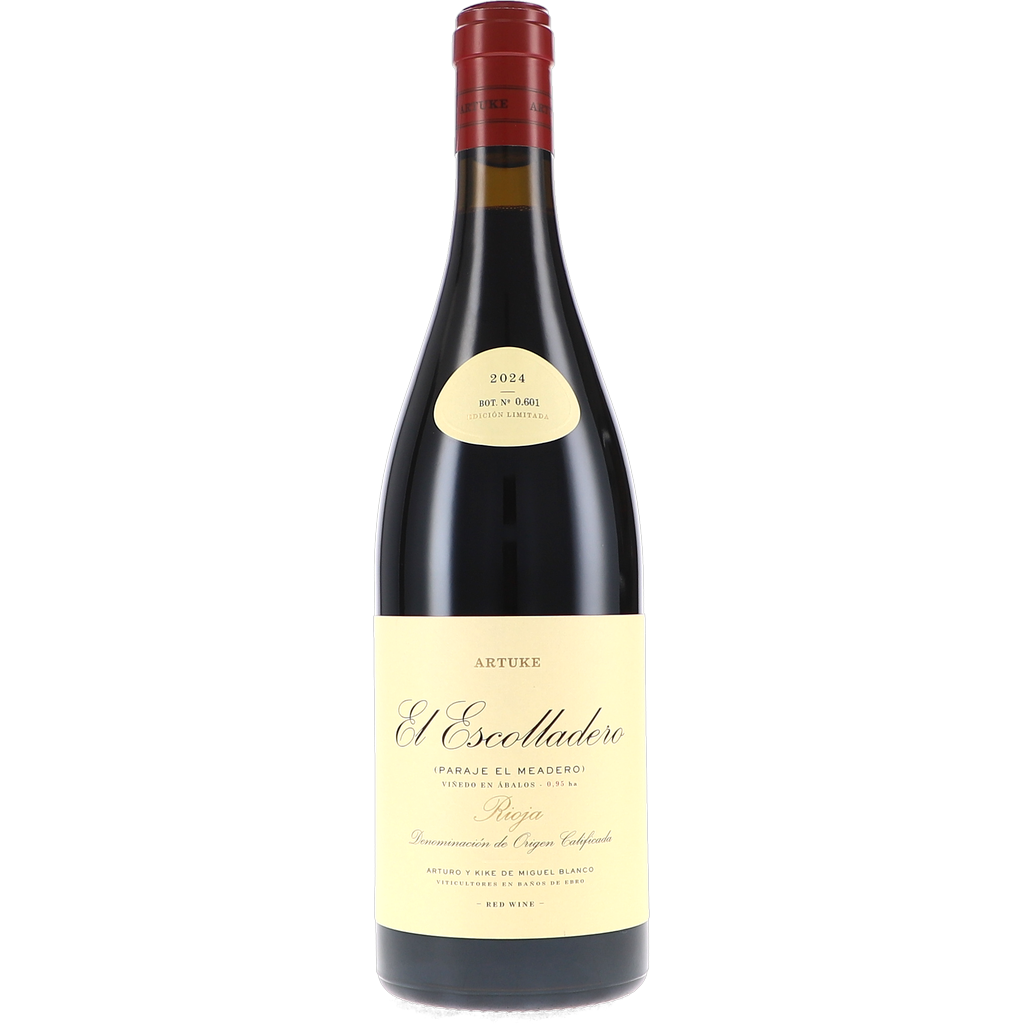
El Escolladero 2024 by Artuke: An elegant, terroir-driven red wine from Rioja Alavesa that combines the freshness and minerality of high-altitude vineyards with the complexity of old vines.
Bottler: Bodega Artuke, La Serna Kalea 24 , 01307 Baños del Ebro, Mañueta / Spain
In the glass
Colour
Deep ruby red with violet reflections.
Nose
Aromas of dark berries, cherries and fine herbal notes, underpinned by subtle hints of spice and mineral nuances.
Palate
Precise and fresh on the palate, with a fine tannin structure and an elegant balance of fruit and acidity. The mineral imprint of the limestone soil lends the wine depth and complexity.
Character
A wine of striking elegance and precision that reflects the uniqueness of its terroir in every facet. The combination of Tempranillo and Graciano ensures fascinating complexity and longevity.
Pairing
Ideal with grilled lamb, spiced tapas or mature Manchego cheese.
Notes
El Escolladero comes from a single vineyard in Ábalos, where 85% Tempranillo and 15% Graciano from vines planted in 1950 grow on clay-limestone soils at 600 metres altitude. These particular conditions give the wine its characteristic minerality and freshness.
Tasting note
Character
Precise, cool and impressively fresh – a Rioja that leaves behind the region’s heavy, oak-dominated clichés. Here, brothers Arturo and Kike de Miguel Blanco craft a wine of Burgundian clarity: structured, distinctly mineral and possessed of an elegance more reminiscent of fine Pinot Noir than of classic Spanish red wine.
Terroir & Origin
The vines are rooted in calcareous clay soils at 600 metres’ altitude in Ábalos, one of four municipalities forming the mosaic of Rioja Alavesa. At these elevations, between 550 and 720 metres, cool nights ensure the precise acid structure that lends the wines their distinctive freshness. It is a terroir once acquired by the winemakers’ grandfather as “El Loco” – today, this extreme altitude proves to be a visionary advantage in the face of climate change.
Grape Varieties & Vinification
85% Tempranillo and 15% Graciano from vines planted in 1950. The brothers farm organically, with an increasingly biodynamic approach, and eschew cultured yeasts and aggressive filtration in the cellar. Maturation takes place in large 600-litre casks, giving the wine space to develop without being overwhelmed by wood – shorter ageing periods than is customary in the region preserve its freshness.
Food Pairings
The structured freshness and mineral depth of this wine call for dishes with substance but without heaviness. Ideal with grilled lamb with rosemary, wild mushroom risotto or pan-roasted duck breast with herb jus. It also reveals its versatility alongside aged Manchego or paprika-spiced cured meats.

 EN
 DE
 FR
 IT