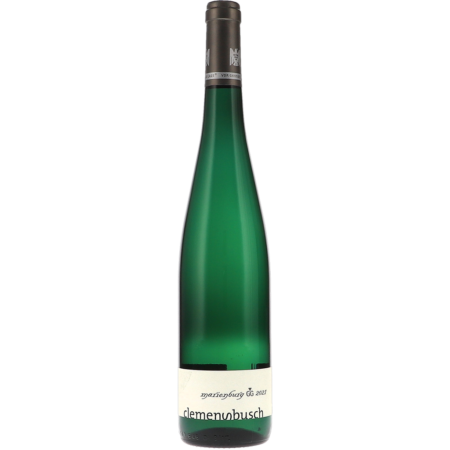
Bottler: Winery Clemens Busch, Kirchstrasse 37, 56862 Pünderich / Germany
In the glass
Colour
Pale straw yellow with greenish reflections, clear and bright in the glass.
Nose
Ripe citrus fruits, white peach and green apple, underpinned by fine slate minerality, herbal spice and a hint of smoky depth.
Palate
Taut and precise on the palate, with vibrant acidity, saline minerality and a long, complex finish; maturation on fine lees lends additional texture and depth.
Character
A powerful, profound Riesling of seismic minerality, showcasing the elegance of the Marienburg alongside the intensity of old, deep-rooted vines.
Pairing
Ideal with pan-fried fish with herb butter, light poultry in a citrus sauce or matured hard cheese.
Notes
From the Grosse Lage Marienburg on blue slate, spontaneously fermented in old foudres, biodynamically certified (Demeter) and awarded the Robert Parker Green Emblem.
Tasting note
Character
This dry Riesling from the Pündericher Marienburg displays a seismic minerality that is truly unparalleled. The aromatic profile oscillates between citrus fruits, white peach and a smoky depth reminiscent of damp slate and herbs. On the palate, a crystalline structure unfolds with fine acidity, rendering the wine taut yet profoundly layered. A wine of linear elegance that articulates its origin with absolute clarity.
Terroir & Origin
The Marienburg ranks among the legendary vineyard sites of the Mosel. Here, the vines root up to eight metres deep into the slate bedrock – a depth only achievable because Clemens Busch has abstained from herbicides since 1976. Three slate colours define the terroir: red, grey and blue. The Fahrlay benefits from this geological diversity and the particular exposure of the steep slope. The ungrafted vines access mineral strata that shallow-rooted vines could never reach – a natural buffer against heat and drought.
Grape Variety & Vinification
Riesling in its purest form. Clemens Busch has farmed biodynamically since 1986, holding Demeter certification since 2015. In the cellar, patience and restraint prevail: 80 per cent of the wines ferment spontaneously in centuries-old 1,000-litre foudres, without cultured yeasts, enzymes or fining. Some wines take over a year to complete fermentation. Extended maturation on the fine lees lends additional complexity, whilst sulphur additions remain minimal. The result is a wine of artisanal precision and natural depth.
Food Pairings
The taut acidity and mineral structure make this Riesling an ideal companion for grilled fish, particularly trout or pike-perch. It also pairs beautifully with white meats such as veal or poultry. Its smoky depth harmonises with smoked salmon or Asian dishes featuring ginger and lemongrass. For those preferring regional fare, try Moselle trout with almond butter – a classic that reaches new dimensions here.

 EN
 DE
 FR
 IT