Tasting note
A wine that initially opens the door only a crack — and then reveals an entire hall. Ester Nin and Carles Ortiz, known for their biodynamic steep slopes in Priorat, prove here that they are equally devoted to Catalonia’s rare white wines. Parellada, otherwise the quiet workhorse of Cava, appears here in its pink-skinned mutation Montonegra — and as one of Spain’s most idiosyncratic still wines. Anyone expecting a well-behaved white will be surprised; anyone who gives it air and time will be rewarded.
- Colour & appearance
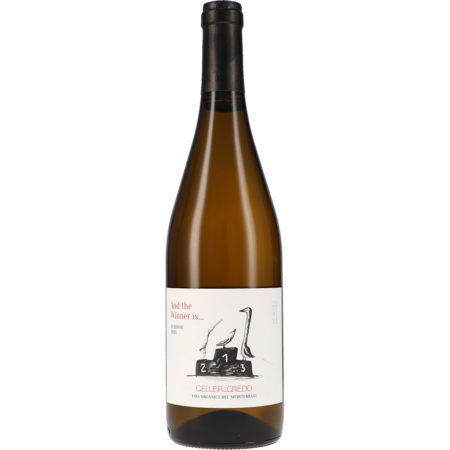
- Pale to medium straw yellow — remarkably pale, even though the berry skin of the Montonegra mutation veers towards pink.
- Nose
- Initially reductively closed: cap-gun caps, sulphur matches, petrol — associations with great, restrained whites from Burgundy or the Nahe come to mind. With plenty of air, the bouquet opens up to preserved lemon and limequat, tahini and lemongrass, along with petrichor and bare stone. Entirely individual, impossible to place anywhere else.
- Palate
- More accessible and fleshier than the nose suggests: juicy fruit in the pale yellow to green spectrum, underpinned by saltiness, plus zest, tart herbs, white and yellow blossoms, pollen, perhaps wild fennel and a hint of ginger. Fresh acidity, tension and pure energy carry the wine — at just 12% vol.
- Finish
- Long, mineral and saline, with an aftertaste of stone and citrus zest that lingers on the palate.
- Terroir & origin
- The grapes come from a vineyard situated at 550 metres in the Alt Penedès near Pla de Manlleu; the wine is named after the red (vermella) clay soil (terra). Ester Nin and Carles Ortiz, the couple behind the Priorat estate Familia Nin Ortiz — biodynamic since their first joint vintage in 2008 — discovered the rare Parellada Montonegra here on one hectare.
- Grape variety & vinification
- 100% Parellada Montonegra, the pink-skinned mutation of the Catalan Cava variety. Crushed, 24 hours of maceration, slow pressing, spontaneous fermentation and ageing in a 300-litre cask.
- Food recommendations
- The saline, reductive coolness calls for substance: Bacalhau à Brás, aubergine caviar with cod and lentils, or dry-aged Toma pork from Schwäbisch-Hällisch pigs with fennel salad.
- Special features
- A grape variety that exists almost nowhere else, vinified by an estate that belongs to the Renaissance des Appellations — the association of leading biodynamic producers. Decanting is essential; patience here is rewarded with an aromatic complexity one would hardly have expected from Catalonia.