
 EN
EN  DE
DE  FR
FR  IT
IT 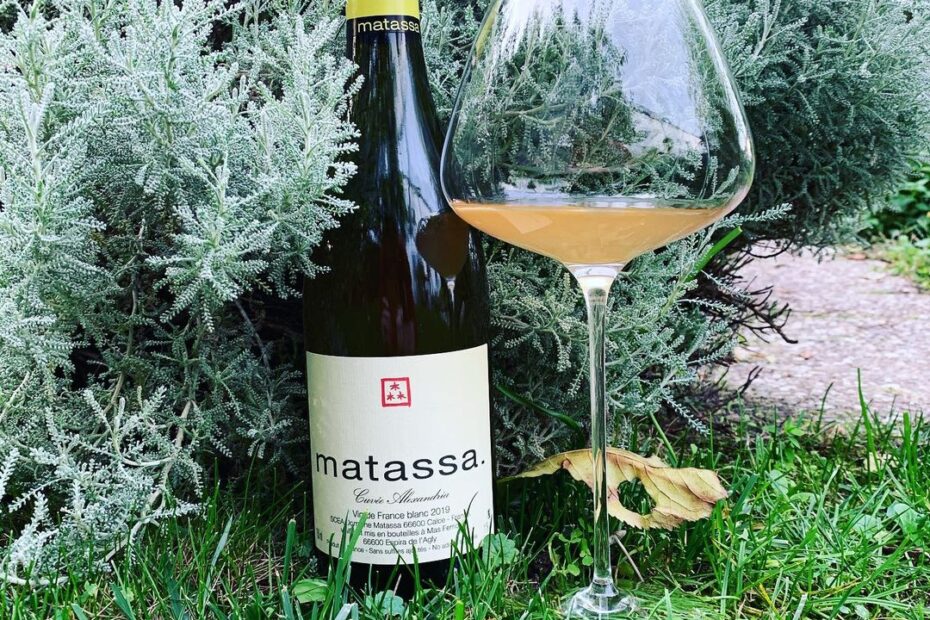
How does a New Zealander who grew up in South Africa end up founding an iconoclastic winery in Roussillon? It’s hardly commonplace, but that’s everything about Tom Lubbe from Domaine Matassa. In the late 1990s, Tom worked at South Africa’s only winery that employed spontaneous fermentation and low yields. Since he was interested in working with Mediterranean grape varieties, Tom was able to complete a three-month internship at the legendary Domaine Gauby in the village of Calce. Gérard Gauby quickly befriended Tom and asked him to work as a cellar assistant for three consecutive vintages. During this time, Tom met his wife Nathalie, who happened to be Gérard’s sister.
The birth of their first child prompted Tom to reconsider returning to South Africa and instead remain in Calce to establish his own winery. Matassa was founded in 2003, with the first vintage produced entirely in the newly-married couple’s living room. Gérard felt so badly about this that he gifted Tom the old Gauby cellar in 2004!
Tom works with many of the traditional Catalan grape varieties: Carignan, Mourvèdre, Grenache (primarily Lladonner Pelut, the old Catalan “clone” of Grenache), Grenache Gris, Muscat d’Alexandrie (the Cuvée Alexandria is a prime example) and Muscat de Petits-Grains. These grapes are often planted together, particularly in the very old vineyards. In total, 20 hectares are cultivated on slate, marl, black slate and black marl soils. Whilst Tom still manages some of the very low-yielding old vines around the village of Calce, he has expanded significantly into other areas where yields are somewhat more generous, typically in the range of 25/30 hl/ha (still relatively low for the region).
The vineyards are managed naturally without any chemical inputs. Tom is certified organic by Ecocert. And whilst he occasionally employs biodynamic techniques to activate and nourish his soils, this has lost priority over the years. Instead, a relentless commitment to ground cover has completely transformed his soils and thus his wines. Tom is convinced that the increased insect life in the soils, particularly worms, has altered the aromas of his wines, specifically with regard to malic acid. Another interesting effect: the dramatic reduction in alcohol content. Tom has always harvested much earlier than most others, typically beginning with the Muscat in early August. In 2005, the wines typically reached 13.5% alcohol. In 2018, they came in at 10.5%.
Much has also changed in the cellar over the years. All Matassa wines are now deliberately declassified as Vin de France. As mentioned, alcohol content is much lower, rarely exceeding 12%. The white wines are all skin macerated, a choice that dates back to the 2008 Alexandria, the first Matassa wine of its kind. With the red wines, maceration and extraction are preceded by whole-bunch infusion, with white grapes often co-fermented. When oak is used, it is intended to provide oxygen rather than structure to the wine. The wines are bottled without filtration or fining.
Sulphur, which Tom had also used judiciously in the past, has not been added to any of the wines since the 2015 vintage.